
Secrets of the Cicada

Updated: Aug 13
Most of us know cicadas by sound. They fill summer afternoons with their calls, leave empty shells clinging to trees, and sometimes emerge in numbers that are impossible to ignore. But scientists studying cicadas at a much smaller scale have discovered something remarkable on their wings.
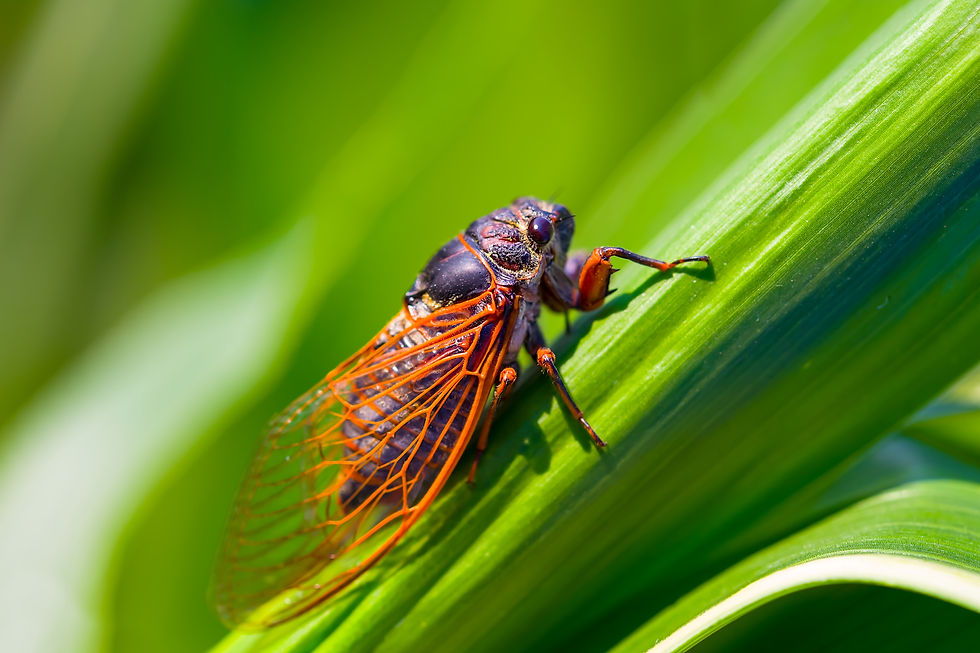
Some cicada wings can kill bacteria. The effect does not depend on antibiotics or a chemical coating. Instead, it comes from the physical structure of the wing itself.
Under a powerful microscope, a cicada wing is not smooth. Its surface is covered with tiny structures known as nanopillars. When certain bacteria land on the wing, these structures can place stress on the bacterial cell membrane, causing it to stretch, deform, and in some cases rupture.
Researchers have been studying this phenomenon for more than a decade. The discovery has led scientists to experiment with manufactured surfaces that imitate the microscopic structure of cicada wings. The goal is to determine whether the same basic design could be used to reduce bacterial growth on materials used in hospitals, food processing, medical devices, and other settings where contamination is a concern.
The idea is especially interesting because the antibacterial effect can be physical rather than chemical. Instead of placing an antimicrobial substance on a surface, the surface itself could be designed in a way that makes it difficult for bacteria to survive.
There are still many questions to answer. Different species of bacteria respond differently, and the exact size, shape, spacing, and arrangement of the microscopic structures can affect how well the surface works. Scientists also have to determine how these designs can be manufactured economically and whether they will remain effective outside controlled laboratory conditions.
Still, the research provides another example of biomimicry, the practice of studying natural systems for ideas that can be adapted to human problems.
Nature has been doing this kind of engineering for a very long time. Burrs helped inspire hook-and-loop fasteners. Lotus leaves have influenced the development of self-cleaning surfaces. Shark skin has been studied for materials that resist the attachment of organisms. Cicada wings are now providing another model, this time for surfaces that may help control bacteria.
There is also a larger conservation lesson in this research.
We often talk about protecting biodiversity because wildlife has value in its own right, because healthy ecosystems support clean water and air, or because future generations deserve to inherit a living world. All of those reasons are important. But there is another reason that receives less attention. We still do not know everything that exists in nature.
A common insect may possess a physical structure that contributes to a new medical technology. A plant may contain a useful compound that has never been studied. A fungus may perform chemistry we do not yet understand. Relationships within an ecosystem may offer solutions to problems that humans have not yet learned how to solve.
When a species disappears, we lose more than an animal or plant. We may also lose information before we ever had the opportunity to understand it.
A species lost before it is understood is a library lost before anyone has learned to read it. That is one reason conservation and scientific discovery are closely connected. Protecting biological diversity preserves not only living communities but also possibilities. Every species represents the result of millions of years of adaptation to particular environments, pressures, competitors, diseases, and changing conditions.
The cicada is a good reminder of how much remains hidden in plain sight.
For generations, cicadas have been sitting in trees with these microscopic structures covering their wings while humans searched for better ways to control harmful bacteria. The solution was not hidden in some distant place. It was above our heads every summer.
We simply had not looked closely enough. Sometimes conservation begins with recognizing that the natural world still has a great deal to teach us.

You don't need to travel to a distant rainforest to encounter something science has not fully understood.
Preserves, parks, backyards, roadsides, wetlands, and even individual trees contain complex communities that are easy to walk past without noticing.
At Chipco Preserve, we protect habitat not only for the species we recognize, but for the relationships, adaptations, and the natural gifts we have yet to understand.
Look closely. Record what you find. Protect the places that still give us something to discover.
KEEP EXPLORING
What happens when we lose something before understanding it? Read about Endlings
What happens when we stop funding the science that helps us understand it?Cutting Bee Science Risks Our Food System


Comments